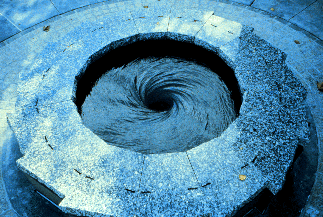
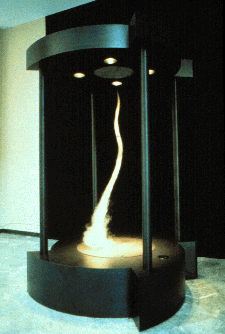
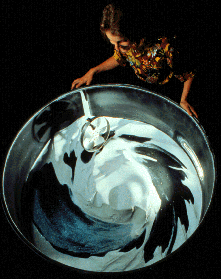
From 29 June 1996 to 5 January 1997 San Francisco's Exploratorium, the noted museum of science, art, and human perception, presents Turbulent Landscapes: The Natural Forces That Shape Our World. This landmark exhibition, funded by the National Science Foundation, presents works that use the forces of nature to capture and expose the complex and seemingly chaotic processes of nature---whirlpools, swirling sandstorms, eroding cliffs, avalanches, tornados.
The thirty turbulent landscapes on display harness nature's forces, allowing nature to reveal herself by condensing causes and effects to human scales. In Kahn's Aeolian Landscape, for example, visitors can alter the direction of air blowing across sand and, in minutes, watch and alter the formation of dunes. Turbulent Landscapes uses fog, wind, smoke, sand, water, gas plasma, slime mold, and other natural phenomena in ways that are ethereal, beautiful, mysterious, sensual, and playful. Yet, it's also an exhibition that touches on compelling questions about complexity, the emergence of order and disorder in the universe, and our perception of that process.
What follows is a dialog between Jim Crutchfield, Turbulent Landscapes's scientific advisor, and Ned Kahn, its designer and curator---a scientist and an artist discussing the nature of patterns, the exhibits, and ways of seeing.
 Jim Crutchfield: To a large extent, the exhibits in Turbulent Landscapes
follow in the tradition of dynamics---the long intellectual trajectory
beginning a century ago with the French mathematician Henri Poincare and
ending with the geometric view of behavior of the seventies and
eighties. One product of this tradition is a fascination with how simple
systems, such as a mechanical pendulum, can appear unpredictable or
"chaotic". The more recent focus on "complexity" is complementary,
reflecting an attempt by scientists to take a broader look at nature, to
extend the mathematics of dynamics to systems that have many, many
components---social organization in ant colonies, bird flocking, and
goods pricing in commodity markets. The central question is, How does
order arise in complicated systems? Turbulent Landscapes encapsulates
the fruition of dynamics and the contemporary effort to understand the
emergence of complexity in nature.
Jim Crutchfield: To a large extent, the exhibits in Turbulent Landscapes
follow in the tradition of dynamics---the long intellectual trajectory
beginning a century ago with the French mathematician Henri Poincare and
ending with the geometric view of behavior of the seventies and
eighties. One product of this tradition is a fascination with how simple
systems, such as a mechanical pendulum, can appear unpredictable or
"chaotic". The more recent focus on "complexity" is complementary,
reflecting an attempt by scientists to take a broader look at nature, to
extend the mathematics of dynamics to systems that have many, many
components---social organization in ant colonies, bird flocking, and
goods pricing in commodity markets. The central question is, How does
order arise in complicated systems? Turbulent Landscapes encapsulates
the fruition of dynamics and the contemporary effort to understand the
emergence of complexity in nature.
What would be good for people to get out of Turbulent Landscapes is this sense of opening up. It would be great if the show conveyed the possibility that science is now beginning to address these complicated systems. Many of the exhibits are physical. And these fit fairly directly into the dynamics tradition. But taking the show as a whole, stepping back from the individual exhibits, you see that it's attempting to encompass a much larger range of complex systems.
Ned Kahn: The questions of emergent order have been there for awhile.
People have been grappling with complicated systems---such as economies,
social systems, and biological systems---for many centuries. But now
there's perhaps a glimpse of hope that there might be some answers.
JC: We are now able to look at more human-scale processes and understand how they work. Part of the show's theme is to get people to appreciate that fairly mundane systems---I don't mean this in a pejorative sense at all, but in the sense of "the everyday"---are actually valid phenomena to look at, to admire, and to study. This is in stark contrast to the kind of science that builds a $6 billion particle accelerator in which nature is highly constrained to test theories that are very far removed from immediate experience.
NK: At the other extreme of the size scale from particle physics, astrophysicists look at structure and dynamics of galaxies and galaxy clusters. It's notable that some phenomena on that scale are easier to understand than how water flows out of your kitchen faucet.
JC: Looking over the history of science and of mathematical modeling, one sees how a great deal progress has been made by focusing on extreme limits. Many examples come to mind: by assuming that effect is proportional to cause, that nature is linear; in the world of probability, by assuming the occurrence of one event is independent of another; by taking the limit of very small scales or very large scales; or by taking systems that have a huge number of components. Each one of these limits is an example of a branch of physics where we've had great success. In contrast, then, one message from the show could be that of bringing our focus of attention back to these intermediate, human scales; that is, we're backing off from the limiting extremes, confronting the complexity around us.
NK: Our minds are amazingly well-adapted pattern recognizers. Wherever you look in nature, it's so complicated. All these different colors, shadows, textures, and movements. All these photons coming in and, none the less, we reconstruct a world out of this raw stimulus. We do this, without even thinking about it. It's what the mind likes to do.
JC: Are the exhibits so tightly designed that they're going to fairly
represent what you've originally intended to illustrate? Or, is there an
inherent randomness onto which people project structure?
NK: People project all kinds of patterns and associations into these systems but that's what makes it art. Artists try to create things that are ambiguous, things with many levels of meaning for people to impose their patterns on.
JC: There's a threshold beyond which there's so much ambiguity that people won't see any structure. This must be the hardest part in creating the exhibits, to play against too much ambiguity. Things that are seemingly structureless are uninteresting. At the other end of the spectrum, a completely straightforward, obvious statement of fact is not engaging. Interesting-ness increases---human interest increases---as you increase the ambiguity. Things in the world that are really intriguing draw you in. Initially, at least, you're a little uncertain about what you'll see, they're ambiguous. Then the structure is revealed and you begin to see patterns.
NK: The graph that you once drew with degree of interest on one axis and degree of randomness on the other was enlightening to me. A perfectly orderly cube of metal at one end of the randomness spectrum and video snow at the other end. The middle ground, that swirling together of order and disorder, is where nature has the greatest opportunity to surprise us.
JC: This brings up a cautionary point. It brings up what I would call a now-conventional view of the word "surprise", which is not the sense in which you just used the word. The mathematics behind this turns on Claude Shannon's work in the forties on a mathematical theory of communication. He came up with a way of quantifying randomness which he labeled with a number he called "information". He argued that his measure of information had to have a certain mathematical form, by saying that events in the world are "surprising" to the extent that they're improbable. When you work through his motivation for this concept of information, you end up with essentially a theory that says structureless video snow is most informative and most surprising.
NK: That's intuitively wrong, but is there a mathematical way you can put this?
JC: Yes, there is an approach, complementary to Shannon's, that proposes
a different mathematical quantity that measures the amount of structure
or degree of sophistication in a pattern. More specifically, it measures
how much computational capacity is required to detect the pattern. But
perhaps the technical details might distract us. I'm actually more
interested in why you think the conventional notion of surprise is
intuitively wrong.
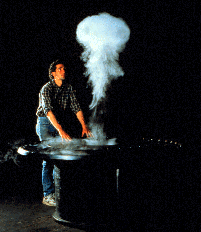
NK: That feeling is hard to pin down, of course. An analogy is the transition from laminar fluid flow around a cylinder to turbulent flow. Initially, you have a slow creeping flow, with nice parallel stream lines. You look at it once and you've got it: the fluid just goes up over this object and smoothly reunites on the other side. At the other end of the continuum---massive turbulence, microscale turbulence, everything flowing all over the place, the fluid analogy to video snow---it's just too complicated for your mind to follow in all its details. The middle ground is complex: where you have separation occurring, vortices being generated, watching the flow start orderly and become turbulent. Seeing the transition, the contrast between order and disorder, is what is really fascinating. This is what almost everything in the show is about, the strange phenomena that emerge in this zone between order and disorder.
JC: Right, complexity at the order-disorder border. There are a couple of different ways to think about the intermediate regime. One stance is that we're observers and our brains have a certain capacity for detecting regularity. To the extent that the world matches these characteristics of ours, we can see structure and pattern. To the extent that behavior in the world exceeds our capacities, the excess amount of sophistication in the stimulus is lost on us and turns into randomness, into apparent structureless-ness that we can't represent. The result is a regime of complexity and structure that we can detect that is a direct product of the competition between our capacities and the world's intricacy. To be frank, I don't know how to go from this to saying what's humanly interesting or not interesting. The analogy seems intuitively plausible, though: a regime of maximal human interest that emerges from our perceptual and cognitive limits to recognize patterns.
NK: In this show there are all different kinds of phenomena---sand dunes
formed by blowing air, sand sculpted by moving water, water waves
created by wind, high voltage plasma oscillations, salt crystals
forming, clay being eroded by water, slime mold growing. What's
intriguing to me is that very diverse systems display similar movements,
similar kinds of flow patterns. The mathematician Ralph Abraham used a
phrase---the geometry of behavior---to describe how there can be an
underlying geometry of movement, of flow patterns, the same way there's
an underlying geometry of static objects, such as crystals. Spheres are
an example. They are ubiquitous in nature because their geometry makes
sense, you get the smallest surface area for a given volume. Planets are
spheres, bubbles are spheres. In a similar way certain flow patterns get
reused. A vortex is a classic example. You can see vortices in a stream,
an atmosphere, a galaxy. What is it about these shapes that makes them
recur over vastly different scales and in very different materials?
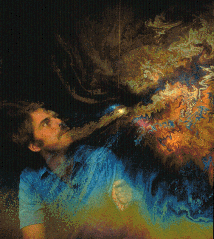
JC: There are several different kinds of commonality: Dynamical similarity where two different systems share the same shape of behavior in their state spaces. Commonality also arises from constraints in those shapes and in how behavior can change as you vary a control parameter. The mathematical theory of dynamical systems and the physics of phase transitions show us how these commonalities arise in nature.
NK: Turning back to art. Many of these recurring flow patterns in nature are also ubiquitous in art. You can go back through the whole history of art and find spirals, meanders, and branching patterns. They're some of the first images that humans started recording historically.
JC: That brings up the question of how we see patterns we've never seen before. What comes first? The experience of them and then they become templates? Or, is there some way that we just naturally are drawn to them? Are they simpler to represent cognitively? We and other cognitive animals seem to have an innate ability to quickly build models of pattern forming processes. These are models not in any explicit mathematical sense but rather are embedded in the dynamics of our brain's neural hardware.
NK: It's what our minds are constantly doing, building models of the world. The world is so complicated. People spend their whole lives trying to make sense of complication even if they're not aware that they're doing it. That's really pretty much most of what we do here.
JC: Yes, we're pattern recognition engines. How do you take this ability of your audience into account when you start thinking of a piece? To come up with something interesting, how do you choose phenomena?
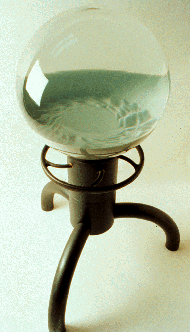
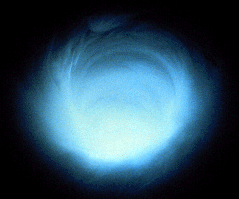
NK: Once in awhile I'll start off with an idea or I'll see something in
nature that's intriguing. The piece Fluvial Storm was inspired by
watching a stream meander over a beach, towards the sea. Fresh water
slicing down through very uniform sand would build up into underwater
dunes that would keep building up, steeper and steeper, moving backwards
against the current and getting steeper, until there would be a rush and
they would just dissolve into turbulence and be completely annihilated.
Then they would slowly start to build up again. I watched for hours,
thinking of how could I create a system that would behave like that. The
result was a glass vessel about twenty inches in diameter filled with
water and sand that viewers could spin and see a similar process.
Sometimes I start with a jumping off point like that. More often, though, I just arrive at these things through building something that's a total failure but discovering something along the way that's interesting. I'm an empiricist. Some things I think are great at first and then I get bored with them and forget about them.
JC: Are the pieces you put out on the exhibition floor, those that pass the test of your staying interested?
NK: Yes, but one out of ten gets past that stage. It gets back to what we were talking about before. The phenomena that fall in that middle ground between order and disorder are the ones that get realized. I've noticed whenever I stumble across something that makes me laugh, I'm often on the right track. And I don't know why. Perhaps, its the joy of seeing nature do something amazing. It just brings up laughter. So when that happens I know I'm on the right track.
JC: When you were talking about the beach with the stream flowing into
the ocean, you focused on that buildup of the wave and it's collapse.
You wanted to capture that and show it to others. Your description gave
me a much more vivid picture of how, through your art, you're engaged in
a different kind of communication with your audience. It's a different
kind of iconography from that found in other kinds of art. What you're
talking about are pattern forming processes, temporal processes. It's
not that you can take a snapshot and say, "Here, see the lump in the
water? Believe me, in the next two seconds it suddenly, mysteriously
disappeared". The fascination is not so much in the objects in and of
themselves, but how they go through their changes.
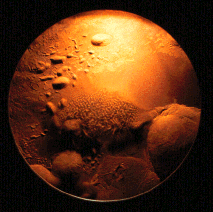
NK: It's something that Frank Oppenheimer, the Exploratorium's founder, taught me. If you're wandering through the woods and you see something beautiful, the first thing that goes through your mind is this feeling of awe, but the next impulse to come along is, "I want to show this to someone". In a way the entire Exploratorium is an expression of this impulse. That's how I see my art too. My whole process is those two things. Seeing something and then wanting to show it to people. Of course, the wanting to show it to people part involves spending five years trying to get it to function right, making it so children don't injure themselves or tear the knob off it. There's that one moment of inspiration and five years of trying to make it work.
JC: I'm way out of my depth here, but do painters, say, have that same kind of attitude that says, "Oh, I want to show you this"? Superficially, to me it seems as if there's a different communication, a different stance that I have to adopt in front of a Picasso. Frankly, I find it a little intimidating. It's like the artist says, "I've encrypted what I want to tell you, can you figure it out?" Occasionally I do and it's quite wonderful. There's a sense of discovery. But I'm often playing deductive mind games with the artist.
NK: Most artists work as you described. It's their little world and
you're supposed to decode it. I've tried to create things that are about
what's happening right in front of you, right now.
My work has been heavily influenced by practicing Buddhism over the last twenty years. The essence of it is a kind of exercise with your mind; exercises designed to make you aware of what's happening right in this moment. The goal is to be cognizant of all the sensations you're experiencing, hearing and seeing, and feeling, even the mind's activity itself; all of the mind's tendencies of thinking and analyzing and planning and remembering things. The practice is to not get lost in the mind's wanderings. One of the insights that you get out of diligent practice is that, eventually, there's no self that's hearing and seeing. There's just the process of hearing and the process of seeing and the process of thinking. They come so rapidly that your mind jumps from one to the other so quickly that you get this sense that there is something underneath it all. But there are really only these processes. This has been a big influence on my art. I've tried to create an art that's like this in a way. Art that's about this unfolding process.
JC: What you convey in each exhibit is the experience of perception. The
exhibits induce in each viewer their own experience of perceiving the
phenomenon---the vortices or waves or avalanches---on its own terms.
Rather than attaching symbolic representation to them, it's the process
of emergence that's shared and communicated. That process is, in a deep
sense, what pattern discovery and even thought are about.
NK: There is an analogy to what scientists do. Certainly not all, but a lot of science is basically asking a question of nature. That is what I am doing. Putting a frame around a system and letting it unfold through its own dynamics. Letting it create the pattern, letting nature sculpt itself to a pattern. Rather than chiseling it myself or painting it into a pattern, I try to let nature be the composer.
JC: The frame is no longer a square around a flat object. It actually has depth, and the depth is time.
NK: The exhibits are frames around behavior.
JC: This focuses one on the process of pattern discovery: seeing something new, the process of innovating or extending our vocabulary, to see in a new way something that's perhaps very mundane and even initially boring.
NK: Watching the clouds is a good example. Most of the time, we're just
too impatient to sit there and watch, we have so many other things to
do. But if you force yourself to do it---just watch one cloud and watch
it evolve as it moves across the sky---it's just stunning. You see this
thing dissolving at one end and forming at another end. Being created
and then dissolving because of larger flows in the atmosphere. A
visualization of the wind. It goes from something being totally
mundane---"I've seen a million clouds"---to a deeper
appreciation---"That is just amazing".
I was at the playground with my kids the other day. There was little girl, she must have been a year and a half old, who was taking big handfuls of sand and throwing them onto the slide and just watching it run down. This is a little like Juanita Miller's Point of Criticality exhibit in Turbulent Landscapes. She would just throw the sand and then burst out laughing. She was doing it over and over again. And each time it was just as amazing to her. Then her dad rounded the corner, "Don't throw sand on the slide. The slide isn't for throwing sand on." It just hit me that there're all these miraculous things that we get turned off to at certain times. And then decades later, you have to struggle to turn them back on.
JC: Unlearning constraints---getting back to that simple, wonderful naive appreciation of things. What she was seeing? Why the fascination and joy? Perhaps it's through this simple wonder that children bring us back, closer to nature.
Photo. (Credit): "Piece Title" by Artist; Location.